The Route Overview
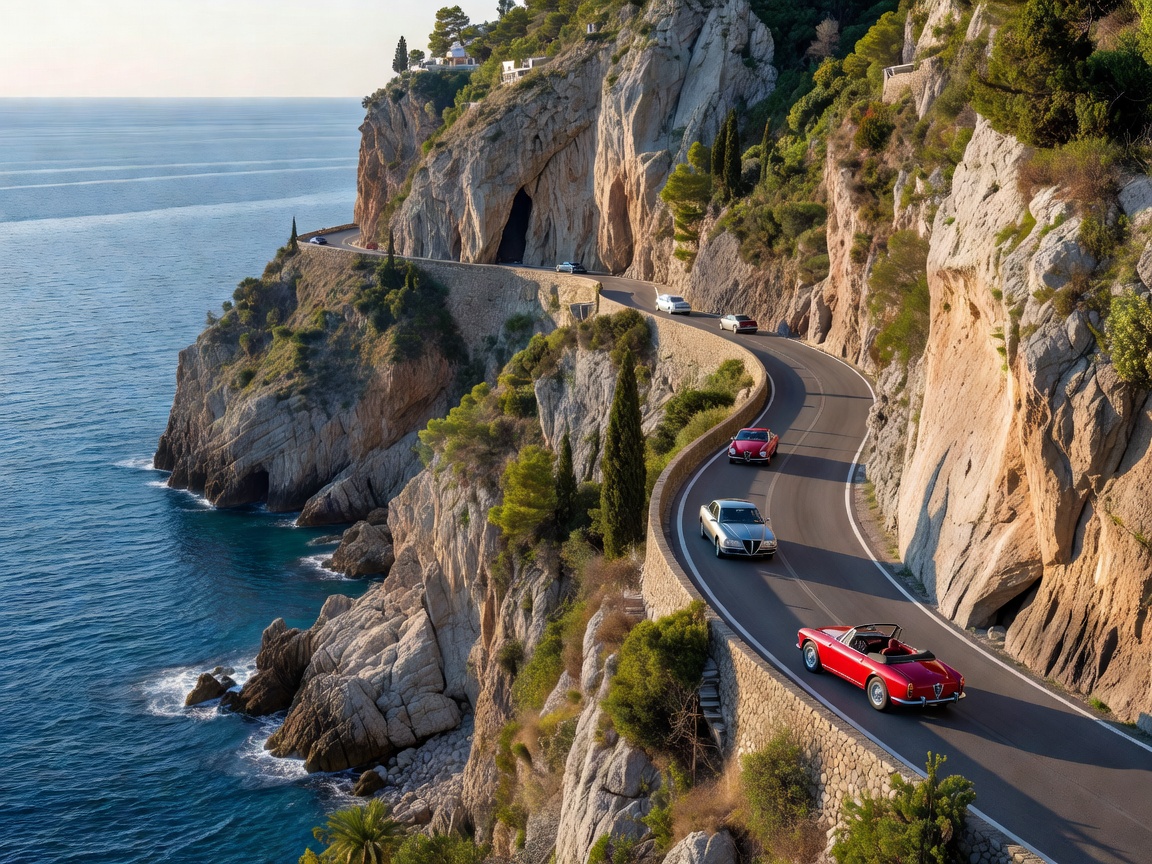
Formally designated as the Strada Statale 163 (SS163), the Amalfi Coast Road is arguably the most famous coastal drive in Europe. Stretching a mere 31 miles from Sorrento to Salerno, it is not a route chosen for its length, but for its sheer intensity and architectural beauty. Carved directly into the plunging cliffs of the Lattari Mountains, the road acts as a balcony overlooking the Tyrrhenian Sea, linking a series of ancient, pastel-colored maritime villages.
Constructed originally by the Romans and heavily modified in the 19th century, the road layout defies modern traffic conventions. It consists of an endless sequence of tight hairpins, blind corners, and narrow bridges. The driving experience is highly interactive. You are constantly negotiating space with oncoming local buses, aggressive scooters, and tourists, all while suspended hundreds of feet above the shimmering water.
Vehicle Specifications & Recommendations
This is not the environment for a large SUV or a wide grand tourer. The golden rule of driving the Amalfi Coast is simple: rent the smallest car you can comfortably fit into. A compact hatchback—such as a Fiat 500 or a small Peugeot—is the ideal tool for the job. The narrow dimensions will save you immense stress when attempting to squeeze past oncoming coaches on sections of road barely wide enough for one and a half vehicles.
A manual transmission is highly favored by driving purists here, allowing for better engine braking on the steep, continuous descents. However, a responsive automatic is perfectly acceptable and will save your left leg in heavy traffic. Importantly, ensure your vehicle has folding wing mirrors; you will frequently need to tuck them in to avoid scraping the ancient stone retaining walls that border the tarmac.
Pros and Cons of the Drive
The Benefits
- Unrivaled romantic scenery, seamlessly blending dramatic topography with historic Italian architecture.
- Exceptional culinary stops available at nearly every turn, offering world-class seafood and local citrus.
- A profound sense of accomplishment upon successfully navigating the complex, highly interactive traffic flow.
The Drawbacks
- Gridlock traffic during peak summer, turning the 31-mile journey into a stressful, multi-hour crawl.
- Extreme scarcity of parking in the coastal towns, often requiring expensive private valets.
- The constant requirement for hyper-vigilance limits the driver's ability to actually look at the scenery.
Key Viewpoints and Essential Stops
The town of Positano is the visual anchor of the route. Approaching from the west, the road rounds a promontory to reveal the town tumbling down the ravine to the sea in a cascade of peach and terracotta facades. While stopping in Positano is difficult due to parking constraints, the view from the roadside pullouts just above the town is iconic.
Further east lies Amalfi itself, the historical powerhouse of the coast. The road drops down to sea level here, providing a brief respite from the cliffside driving. Beyond Amalfi is Ravello, accessed via a steep deviation inland. Ravello sits high above the coast, offering tranquil gardens and sweeping panoramic views that provide a quiet, sophisticated contrast to the chaotic energy of the coastal highway below.
Seasonal Planning
Driving the Amalfi Coast in July or August is an exercise in frustration. The road simply does not possess the capacity to handle high-season tourist traffic. You will spend the majority of your time staring at the bumper of the car in front of you, baking in the Mediterranean sun. Furthermore, local authorities occasionally implement alternate-day driving restrictions based on license plate numbers to combat summer congestion.
To experience the SS163 as it was meant to be driven, aim for the shoulder seasons. Late April to May, or late September to October, offer a perfect equilibrium. The weather remains warm enough for alfresco dining and swimming, but the volume of coaches and rental cars drops significantly. The road clears, the hairpins open up, and the rhythmic, swinging nature of the drive finally reveals itself.